
Air pollution is naturally unpleasant for most of us, so we try to get away from exhaust fumes, smoking fires or burning food, for example. It’s only recently been discovered that the effects of exposure to air pollution accumulate over the years, and can cause significant harm to our health, particularly the health of children.
Carbon dioxide is of course a major pollutant, but it directly harms the health of the planet not of individuals directly, so it is not covered here.
There are increasingly strict regulations to control pollution from vehicles and power stations. But it seems that even in the tiniest amounts of the most harmful of air pollutants can affect us. Improved monitoring means that we understand more and can reduce our exposure, but also that there is more to learn.
For most people in Saltash, the main sources of pollution are:
Outdoors: traffic, especially queuing with engines running
Indoors: cooking (especially roasting), and chemical products such as cleaning materials
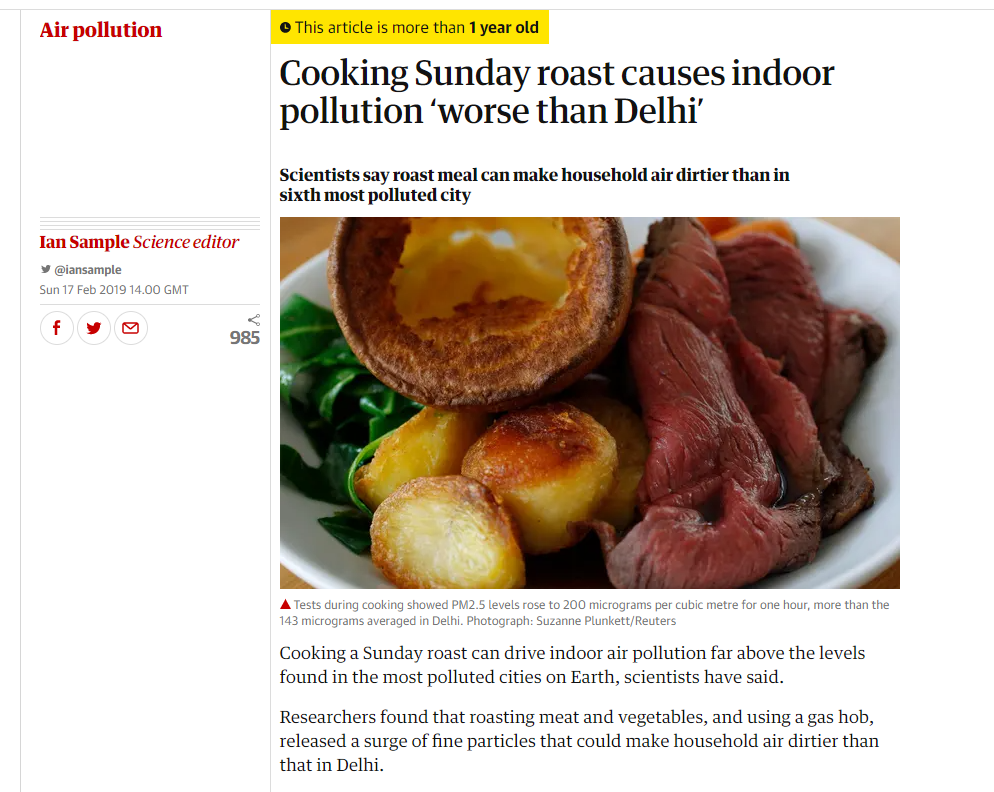
In Saltash overall, pollution from traffic is reasonable, which you can check at the Callington Road monitoring site. And homes can become safer by limiting use of chemicals and by opening the windows for about half an hour each day and when cooking.
Some useful sources of information are given at the end. And if any expert wants to correct the information on this page, please email info@seasaltash.co.uk
Pollution and Health
The effects of air pollution can accumulate even from before birth, and although they may be reversible in the early stages by totally avoiding pollution, in the long run they can also cause serious, and sometimes fatal conditions.
High levels of air pollution during pregnancy causes babies to be smaller (and therefore less healthy) than normal. In children, pollution reduces the size of the lungs and may cause asthma – and cause attacks in those who already have asthma. Pollutants also worsen the condition of adults with lung disease, such as asthma and chronic bronchitis (now known as chronic obstructive airways disease, COAD). And it is has been shown that in the long run pollutants can cause lung cancer, strokes and heart disease. In fact, they are now recognised as a major cause of these common conditions.
Research can compare the death rates of people living in different levels of pollution, and it is estimated that pollution is the basic cause of about 36,000 deaths in the UK every year – about one in fifteen.
There follows a summary of the most important pollutants for people to be aware of, according to current knowledge.
Particulates
Particulate are tiny, microscopic lumps of material that are suspended in the air and blown about, gradually settling on the ground. The smaller they are, the more likely to get into the lungs and even directly into the bloodstream.
This ‘particulate matter’ or PM can be divided into small (PM10) , and very small (PM2.5). The number reflects their size in micrometers (one thousandth of a millimetre). For comparison, a human hair is about 70 micrometers in diameter.
PMs can be made of various substances:
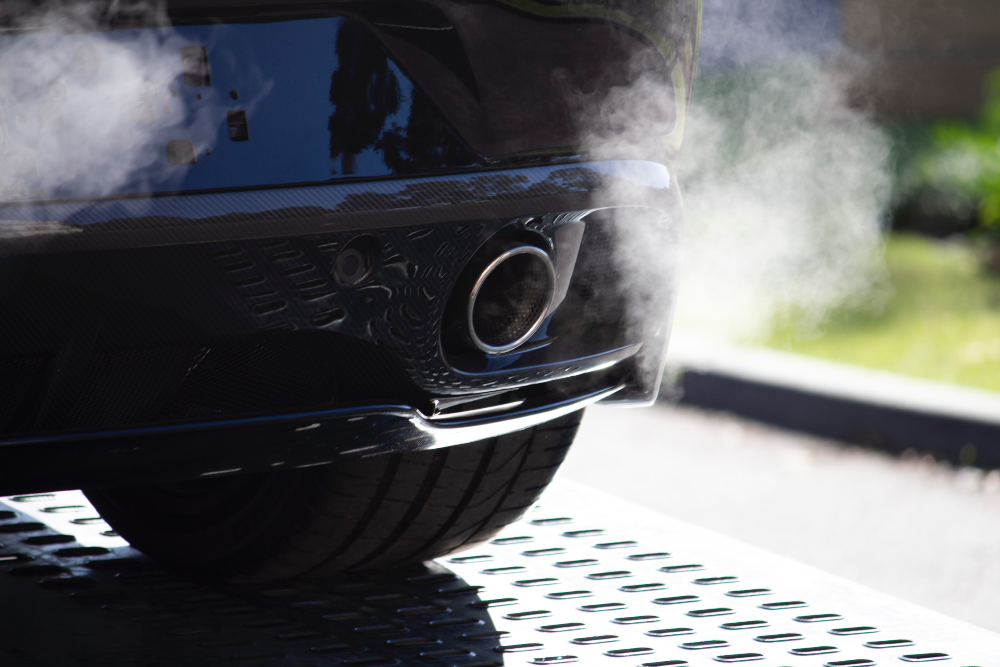
Carbon (soot) – from car and lorry exhausts – it should be filtered out. Carbon particles can carry toxic chemicals on their surface
Brake discs, rubber tyres and the road surface all wear down with traffic, giving off particles into the surrounding air
Tiny particles of chemicals given off when plants and plant materials are burnt. The most obvious example is tobacco smoke which contains many carcinogens. But even the countryside might not be free of these ‘organic’ particles
Water droplets (mist, steam) are harmless in themselves but can carry toxic chemicals on their surface
Other Pollutants
Several gases are a cause of harmful pollution.
Nitrogen dioxide NO2 from vehicle engines is a big risk, though modern filters should cut it down hugely even from diesel engines
‘Volatile organic compounds’ or VOCs are the smells such as given off by petrol, household chemicals, oil-based paint, and so on. Some of these are harmful – though not all (the ‘nose’ of wine is a VOC!)
Sulphur dioxide (SO2) used to be a big problem with coal-burning in the home or power stations, but modern coal is mostly low-sulphur, and power stations now wash SO2 from the smoke in chimneys
Two other gases are highly dangerous in particular situations, and are covered by specific laws. Carbon monoxide (CO) is released when gas appliances burn without adequate air supply; and radon is given off by granite rock in some places.

SEA and Air Pollution in Saltash
David and Adrian, members of the SEA Committee, have purchased a ‘Flow’ meter privately to explore air pollution in Saltash. It measures PM2.5, PM10, NO2 and VOC. It was tested in Bristol university and found to be reasonably accurate. We have taken many readings indoors and out, in the countryside and in the town. We found a great variation in the readings, but often find it difficult to explain the high values of one or another pollutant – it is known that humidity, wind, air temperature and so on affect the readings.
For that reason, we are reluctant to claim that our readings can yet be used to incluence policy.
But there is one situation where we have some confidence in the results – Fore St in the morning rush hour when traffic is queuing because the Bridge is blocked. We first took regular readings sitting outside Superdrug, Fore St, for 3 periods of typical morning rush-hour (8.30-8.45). Then, we took new readings when traffic was stationary at that time on 20th January 2020.
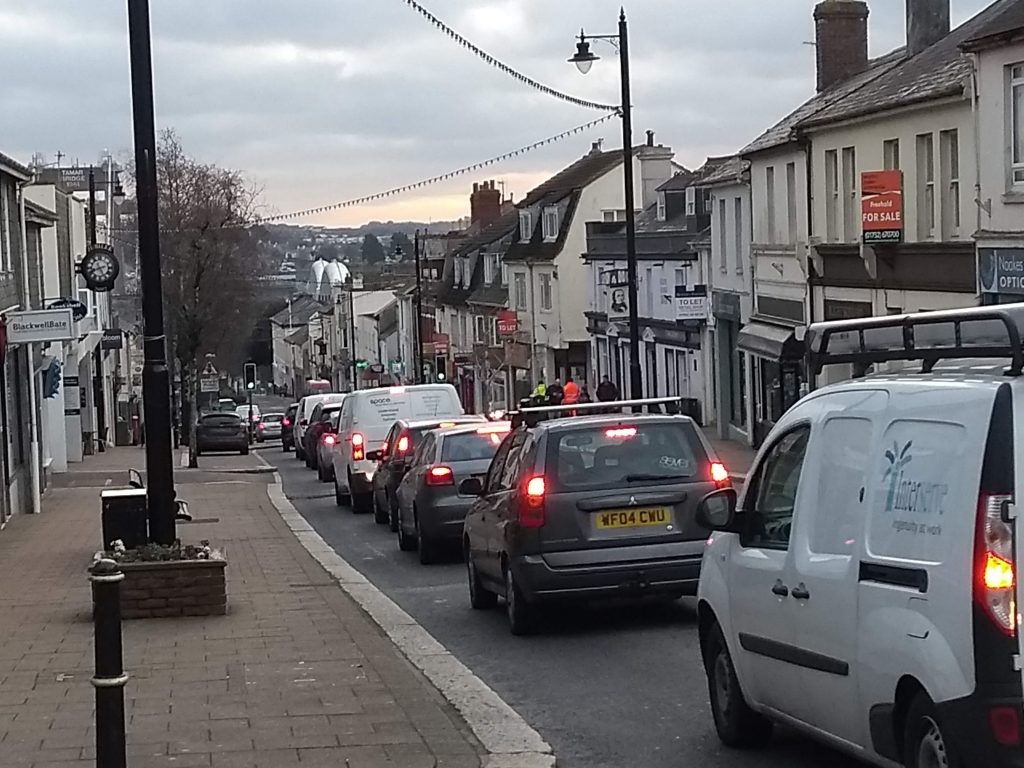
The table shows the average values over 3 mornings in normal morning rush-hour conditions, and the readings when traffic was stationary.
Readings of 4 major pollutants: Fore St morning 0830-0845
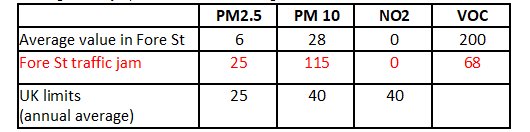
Particulate Matter (PM) of 2.5 and 10 micrometer diameters; Nitrous Oxide (NO2) and Volatile organic compounds (VOC)
So the average levels in normal rush-hour conditions are ‘acceptable’ in the sense that they are within UK guidelines – even though not harmless on long-term exposure. In the traffic jam, the level of the smaller, more dangerous, particular matter (PM2.5) reached the limit allowed for annual exposure. So it was legal but adds to the health risk. Similarly with the larger PM10 values, the higher level in the traffic jam is ‘allowed’ for short periods, but still carries long-term risks. The levels of volatile organic compounds (VOC) are difficult to interpret.
The level of nitrous oxide, a particularly damaging molecule given out especially by older diesel engines, is reassuringly low.
The message seems clear: everyone should switch off their engine in a traffic jam.
Useful Sources Of Information On Pollution
RCP Report Every Breath we Take 2016
www.rcplondon.ac.uk/projects/outputs/every-breath-we-take-lifelong-impact-air-pollution
WHO on air pollution
RAC information on car emissions
www.rac.co.uk/drive/advice/emissions/
Government’s Clean Air Strategy
www.gov.uk/government/publications/clean-air-strategy-2019/
DEFRA site on Air Quality:
Callington Rd data:
uk-air.defra.gov.uk/data/site-data?f_site_id=SASH&view=last_hour station
NICE Air pollution: outdoor air quality and health. 2017
www.nice.org.uk/guidance/NG70 UK Clean Air Day www.cleanairday.org.uk