Few readers of this blog will need reminding of the scourge of plastics that pollute our beautiful oceans. They will know that more than 8m tonnes of the stuff winds up in the oceans every year; they will know of The Great Pacific Garbage Patch which is twice the size of France and hosts 6 kilograms of plastic for every kilogram of plankton, and they will know that over 100,000 marine animals are strangled, suffocated or injured by plastics every year, many dying through blockage of their digestive systems. Just as harmful are the tiny microplastics (less than 5mm in length) that accumulate and persist in the marine food chain; a recent RRS Discovery ocean-sieving expedition has revealed that there are 21 million tonnes of plastic particles suspended in just the top 200m of the Atlantic alone .
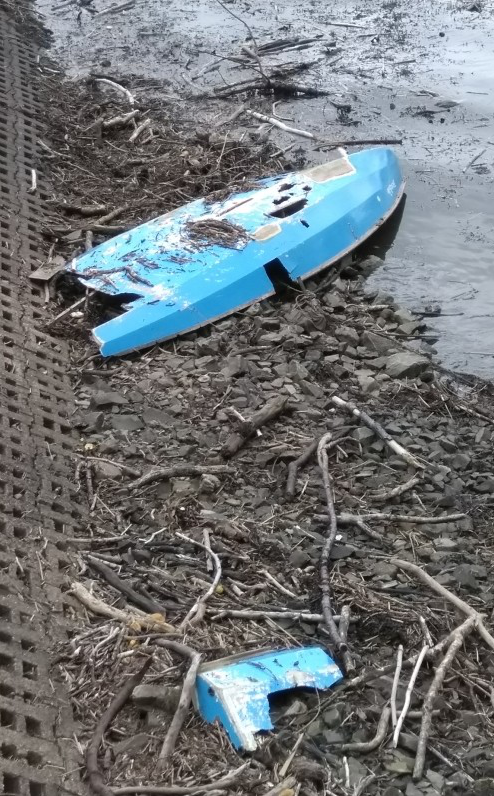
But what of the potential problem of the increasing number of glass reinforced plastic/polyester (GRP) or fibreglass boats that we see abandoned and broken along our coasts? What will become of them? Will they break down into fragments or even microplastics and join the ever growing dump of plastics that pollute our oceans?
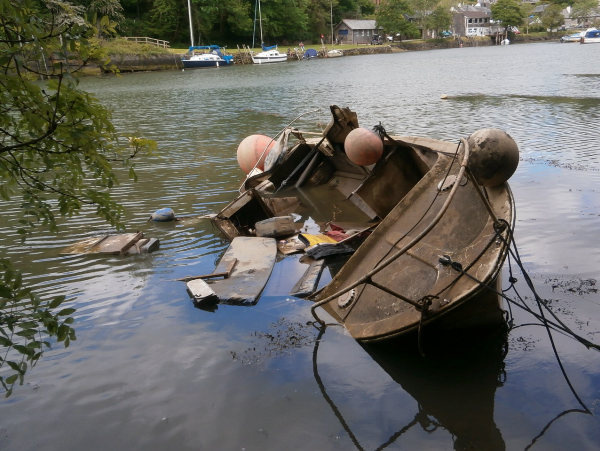
Fibreglass boats first appeared in any great number in the 1960s and 1970s, and it is estimated that, world-wide, between 35 to 40 million of these are now reaching the end of their useful lives. The European Boating Industry, which represents the European leisure marine industry, estimates that around 80,000 boats under 24m reach the end of their lives each year in Europe alone. The UN puts this figure as high as 140,000. In the Caribbean and southern USA thousands of boats are destroyed every year by hurricanes. Where do they all go?
In the UK, proper disposal of fibreglass is usually by landfill but this is not cheap, removal and transport being the major cost. EU research suggests that it costs about €800 to dispose of a 23-footer, rising to €1,500 for a 33-39ft boat and an eye-watering €15,000 for boats over 50ft long. As boats age and lose value they must inevitably end up in the hands of those less wealthy, those less able to afford the significant costs of disposal.
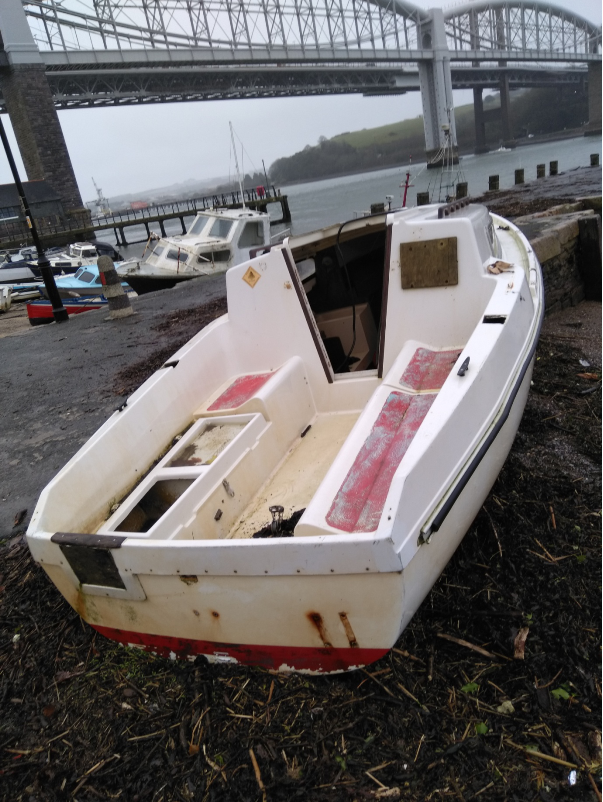
With a car, the value drops and drops with time until it’s worth a steady value of, say, £50 as scrap metal. A boat, however, can easily achieve negative value as its potential disposal costs exceed its selling price. There was a time when young people would buy small, cheap, tatty-looking boats and do them up. Not so much now, alas, as few young people are attracted to sailing and even fewer to boat repair. Too often these boats are bought, stripped of their useful bits and then abandoned. There is a disturbing trend for boats to be sold—on eBay, for example—for as little as £1. Their owners thus escape responsibility and costs of their disposal. There is no legal requirement in the UK to register boat ownership, so dumping a boat is easy—and free.
In some other parts of the world this problem is taken seriously. The USA state of California, (you know, the one that defied Trump’s efforts to undermine the state’s right to fight climate change) has taken a tough approach. Owners found guilty of abandoning a vessel are fined $1,000 – $3,000 plus the considerable costs of removal and disposal. However, the state also funds two programmes: the no-cost Vessel Turn-in Program (VTIP) for recreational boat owners to surrender unwanted boats, and the Abandoned Watercraft Abatement Fund (AWAF) for removal of abandoned vessels that pose a substantial hazard.
France introduced new rules in 2019 under which boat owners have to pay an ‘eco tax’ when registering their vessels (another legal requirement) . This tax will fund the disposal of 22,500 boats by the end of 2023. The Canadian government has paid to have derelict boats removed from its coasts. In 2018, the Swedish government provided €300,000 in subsidies to scrap 500 boats under 3 tonnes, providing the owners paid for transportation to an approved recycling centre.
Meanwhile, in the UK, Rebecca Pow MP, Parliamentary Under Secretary of State for the Department for Environment, Food and Rural Affairs, writes to me that: “On the issue of old fibreglass boats, we are engaging with British Marine and working with regional partners through OSPAR Convention for the Protection of the Marine Environment of the North-East Atlantic to understand best practice in disposal.” Leading the field, then.
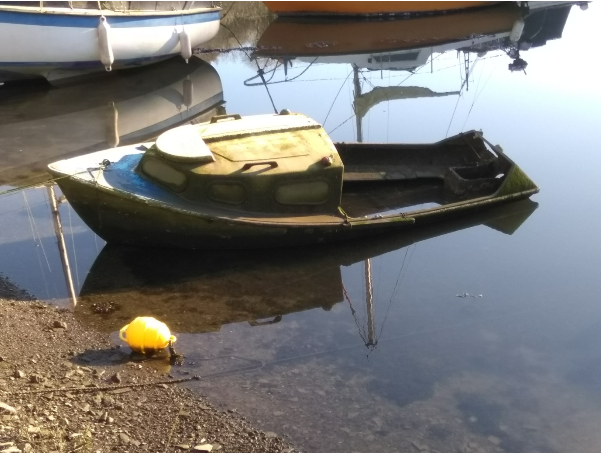
There can be no doubt, surely, that there must be a radical sea change in our attitude towards the disposal of GRP boats, particularly since landfill may not be a viable option for very much longer. Of course, the problem is not only abandoned boats; there are also the many more boats of responsible owners. And boats are not the only source of scrap fibreglass; ubiquitous GRP is used to make oil tanks, kiosks, crash helmets, household insulation, roof tiles, 90m wind turbine blades, fishing boats and small warships, etc, etc, etc. Even the air-frame of the new Typhoon Eurofighter includes 12% GRP (and 70% carbon fibre composites).
I know from experience that a difficult issue faced by local authorities, marinas, clubs, mooring associations etc is what to do with clearly abandoned boats—I can see several from my own house. Even if we take the optimistic view that viable technical solutions will be developed for the bulk recycling of GRP, then there will still remain the problem of how to deal with the situation where one or more well-meaning citizens remove an obviously abandoned boat and then the owner turns up demanding to know what has happened to his much loved and highly valued vessel. Presumably there is a legal solution to this problem but that raises the question of who is to pay for, say, boat survey, legal advice, liability insurance etc on top of the significant cost of the actual removal, transport and disposal or recycling.
So, what is to be done? The first problem to be solved is surely that of boat ownership. You can’t easily dump a car in the UK since it’s numbered and registered, but a boat is not necessarily registered (the Small Ships Register, for example, is a voluntary scheme). Has the time not come in the UK for compulsory registration of all craft at the time of original sale and at any subsequent change in ownership? The incentive to re-register would lie with the seller who would, otherwise, remain responsible for the boat and its subsequent disposal.
The second problem must be the allocation of disposal costs. Perhaps an annual re-registration fee along the lines of the French ‘eco’ tax which is applied to all recreational watercraft, from sailboats to power boats and canoes up to 24 meters (78 feet) in length? A UN-IMO 2019 report, End-of-life management of fibre reinforced plastic vessels: alternatives to in-sea disposal, concludes that ‘The most feasible routes towards funding recycling [of GRP boats] appear to be levy systems on new boat sales and on ownership registration leading to centralised funds to back up vessel recycling programmes’, and that the cost of final disposal of end-of-life GRP boats may rest with the original manufacturers in a similar fashion to the EU WEEE (Waste Electrical and Electronic Equipment ) initiative and the European Directive on End-of-Life Vehicles.
Then there’s the question of what to do with existing abandoned boats and the many more that are likely to appear before any registration and tax scheme becomes established. The answer to that is certainly clear: it is the responsibility of national governments to keep their coasts clear of refuse and the oceans clear of plastics. Here’s looking at you, HMG.
Derek Pilgrim
[Condensed from ‘Where will all our boats go’, Junk Rig Association Magazine no.85, February 2021]