Notes on the trees we appreciated on our last Tree Walk on 25th June 2022
| Saltash tree walks aim to: Share our appreciation of trees in Saltash, with clues on identification (ID) Find suitable trees and encourage everyone to plant them in the gardens of Saltash |
Longstone Park – second visit, starting behind Council Depot
The park was laid out in the post-war period, and most of the trees were planted at that time.
More trees (and pollinator-friendly shrubs and perennials) were added in the Green Infrastructure for Growth (GI4G) project in autumn 2019
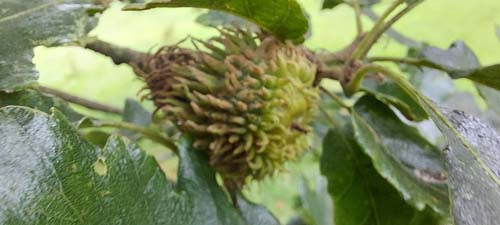
Turkey Oak
Quercus cerris Eventually massive, grows rapidly, fine-looking tree.
Pioneer oak, ie. grows in difficult conditions.
Of limited use to wildlife in the UK, and interbreeds with English oak and dominates it in the natural setting.
ID leaf glossy, 4-10 pairs of lobes or teeth, may be pointed. Acorns typical.
Appreciate: interesting acorns, take 2 years to ripen, the cup is like a woolly cap
Italian alder x2
Alnus cordata from Corsica and S Italy.
Grows in dry poor soil, a pioneer species often used in a roadside planting.
There are 4 in Fore St!
Timber is water resistant – used for piles that Venice is built on ID Tree form, leaf dark glossy green, heart-shaped with pointed tip, male catkins + old cones together in Winter.
Compare with the common alder – A glutinosa likes damp and leaf has an indented tip. Common, native to Britain, often coppiced in the past, and lots around Saltash.
Great examples grow beside Latchbrook Leat, and at Tincombe and many hedgerows round Saltash
Appreciate: holds this year’s green cones as well as old, black cones from last year
Raised mound for wildlife planting GI4G 2019
| Wild cherry (x3) Prunus avium? Probably native cherry, not one of the modern cultivars ID by horizontal lenticels on bark, flowers and fruit in season Appreciate: flowers in spring here and in the cherries edging Callington Rd Also, tall established wild cherries in Coombe Valley make a fine sight in mid-April. |
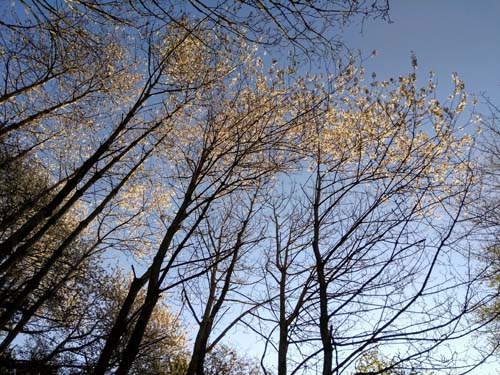
Wildlife friendly area in front of toilets
| Silver birch x4 Betula pendula Pioneer species, useful park and street tree but not very long lived, and may outgrow its situation. Good for wildlife ID small, triangular leaf with toothed margin and smooth leaf-stalk (downy birch has a hairy leaf-stalk) Modern cultivars have better colour bark, and may be smaller and therefore more suitable for gardens. |
| Willow Salix, species unknown Long, narrow hanging leaves that are grey-green in colour. Good for wildlife, but do not plant anywhere near the foundations of a building |
Row of small trees planted November 2019 by GI4G
| Cherry plum Prunus cerasifera great garden tree except that it hates waterlogging or compaction such as cars or footways. Lots planted around Saltash. May be green, or (as here) the purple form, ‘Nigra’ or ‘Pissardii’. This one is fastigiate so grows as a column Appreciate: single flowers very early in spring. |
| Fruit trees Apple, plum and one other not identified Dogwood |
| Cornus from the leaf’s appearance, unsure which species (suggested by Sally, supported by David’s app!) |
| Mountain ash/rowan Sorbus aucuparia Good garden tree, (though occasionally grows v big!) and native, good for wildlife. But hates waterlogging or compaction Appreciate: spring flowers, autumn berries, some autumn leaf colour. Hawthorn |
| Cretaegus monogyna, native tree, good for wildlife, good in reasonable sized garden ID from leaf shape Appreciate: flowers in Spring, red berries in Autumn |
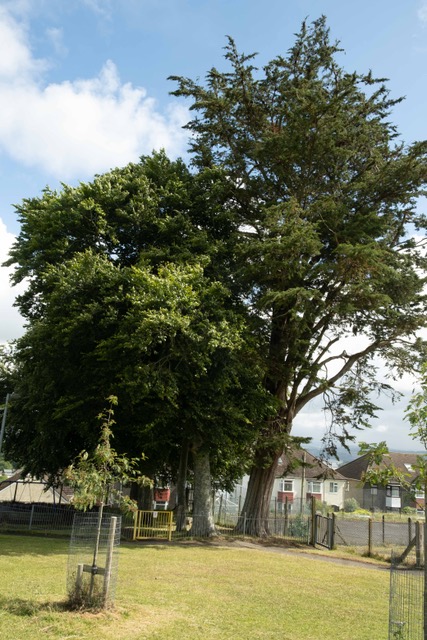
and an evergreen awaiting proper ID – probably Monterey cypress
photo by David Pemberton
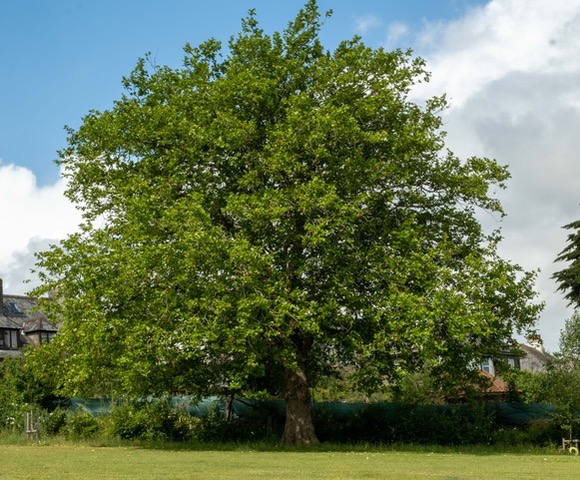
photo by David Pemberton
Along Glebe Avenue boundary of Longstone Park
London plane
Platanus x hispanicus Very tough, tolerant of everything (shade, sun, wet, dry, paving, pollution, salt, pruning) and therefore widely planted in streets – since the 17th century. Its drawback is that the leaves are large and slow to rot after falling in Autumn. Hmm, messy.
See also the photo above, and the pair in the Co-op car park.
ID by overall shape, and ‘geographical’ bark. Leaves are variable but similar to sycamore, fruits are little rough balls about 1” diameter in Autumn
Walnut
Juglans regia from Central Europe, can be massive up to 30m, provides good shade.
ID 7-9 leaflets which are leathery, and the typical fruit.
This particular one is struggling, we’ll try to work out why and succour it
Appreciate: fruit swelling through Summer and Autumn
There is another walnut tree in Plough Green, which is healthier
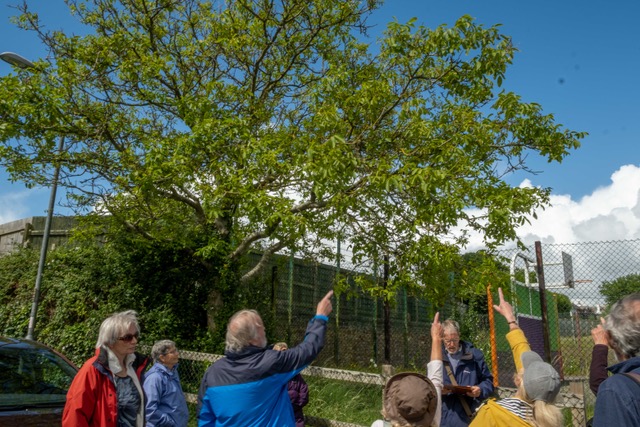
photo by David Pemberton
Victoria Gardens – the Saltash Monterey Pine!
The walk finished up estimating the age of our iconic Monterey Pine. Fred measured the girth at 445cm at chest height. We divided that by 3.13 (which is a factor for pine or spruce – other trees have different factors, averaging around 2.5) to estimate its age at 142 years (1880). In fact, this is near enough: history suggests the tree, and another like it, was planted when Victoria Gardens was laid out, for her Jubilee in 1896. The other Monterey pine is shown in a photo of 1955, but was not in good shape and was eventually felled.
We estimated that this tree is 19m tall, by our inclinometer which told us we were 19m away from the tree when its topmost branches were at 45 degrees according to our app. According to the Treezilla app, this tree has sequestered nearly 3 tonnes of carbon, and has an ecological value of £252.
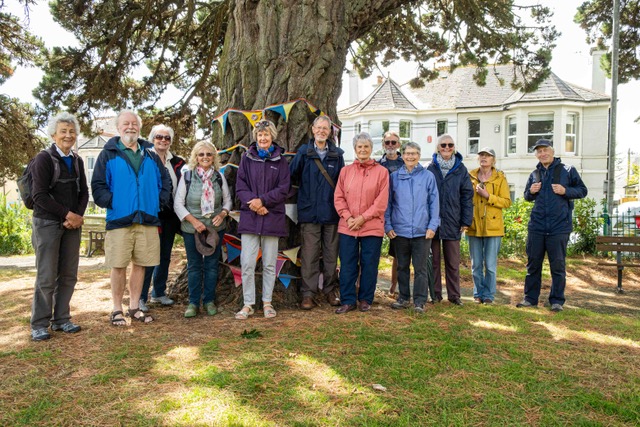
photo by David Pemberton
Saltash Tree Walk 3 will explore Victoria Park in more detail: hopefully on Saturday 23rd July at 10am