A pair of Italian alders resistant to drought and quite commonly planted in towns. All alders tend to be narrow up to middle age, then put on some spread: ID from roundish, dark green leaves, and look out for – particularly in Winter and Spring – last year’s fruiting capsules, after shedding their seeds and turning woody, sit on the tree while the large male catkins grow. The female catkins appear in Spring.
(The native Common alder needs more moisture; it grows well by Latchbrook Leat)
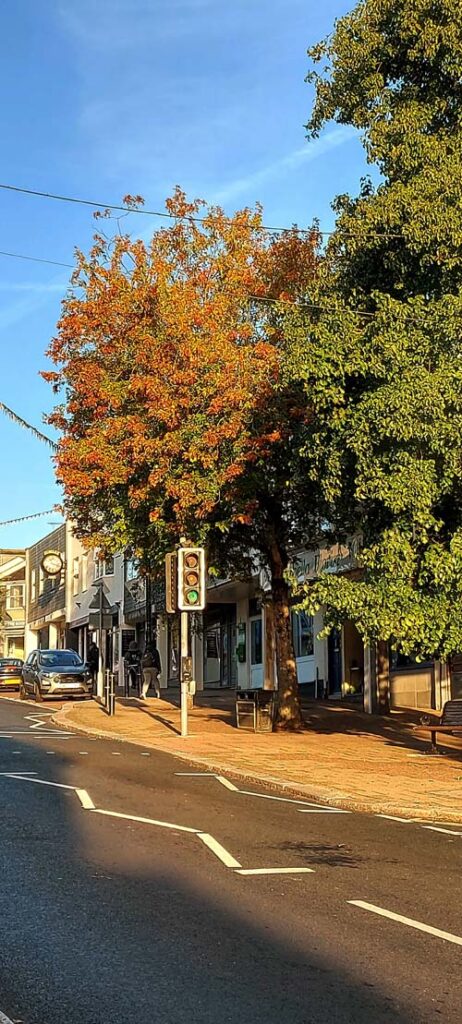
There are 3 silver maples in Fore St. ID from maple shaped leaf and silver underside – shown here in October. This is not native, so doesn’t fruit but can show brilliant colours in Autumn.
Note that the tree outside Baker’s has much the largest trunk (175cm, compared with 120cm for the one outside Oggies’) and is easily the tallest, possibly about 14m. That is too large a difference to be due to local conditions. A clue is given by a photograph in the local history centre showing the Fore St during its resurfacing in 1991: the Baker’s silver maple is there! The only tree seen in these photos, so all the others must have been planted in or after 1991. This matches their current girth of about 120cm (alders and silver maples), since as a very rough guide, a tree’s age is estimated as about half the girth. There is also a row of fine silver maples in Spencer Gardens, which are more obviously silver and may not show such good colour in Autumn.
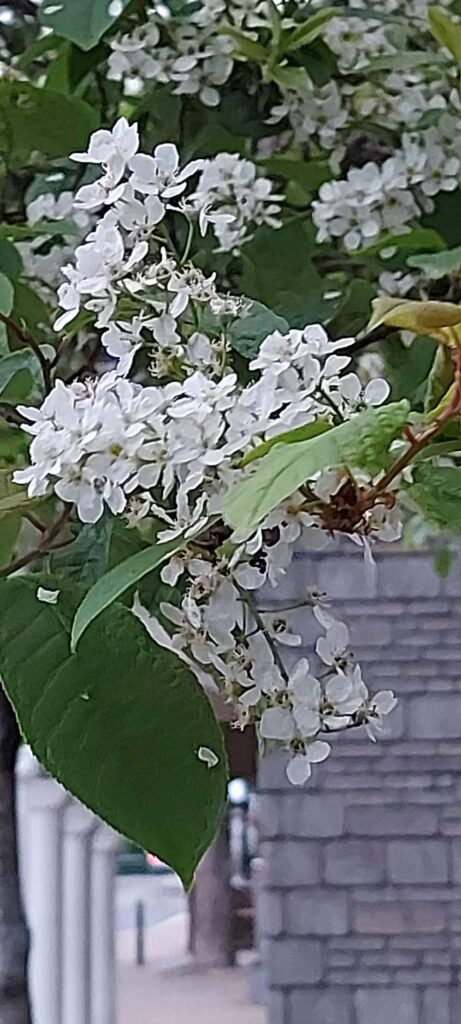
A pair of Bird cherry (Prunus padus) stand outside Superdrug, shown above in early May. The flowers are scented – but a bit high up! British native tree, and some varieties are popular in gardens. ID from the typical ‘cherry’ type leaf, flowers in Spring and 9BITTER) cherry fruit in Autumn.
Silver birches can show good yellow colour in Autumn. Another Italian alder ishere.
A pair of Ginkgo biloba the maidenhair tree, stand outside the Brunel. ID easy from the leaf with two lobes, and the glorious colour in late Autumn. A ‘living fossil’ – which means that the same tree grows nowadays and can be found in fossilised remains – and may live for thousands of years. Can grow tall, but often stays narrow. One has been repeatedly vandalised and the main trunk is broken at about 6 foot (2022). We hope another will be planted in its place.
There is a copse of rowans on the seating area outside the betting shop.
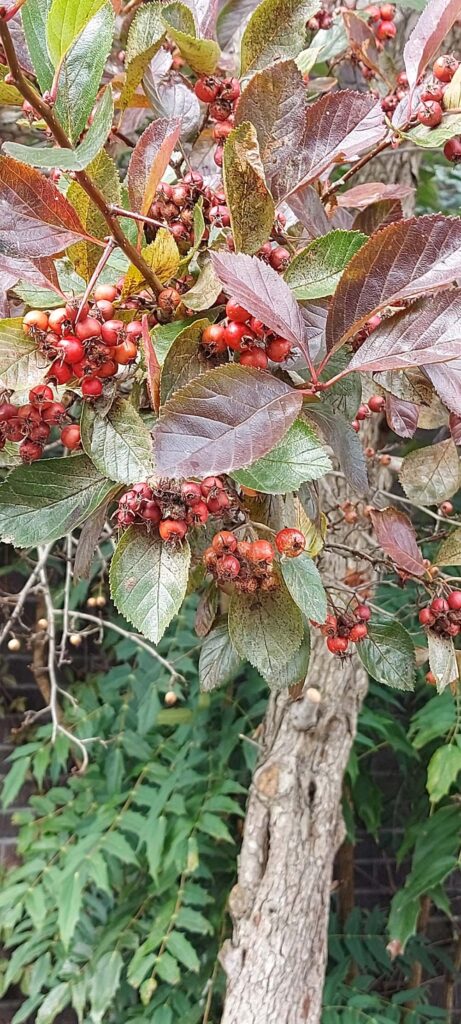
On the corner beside the Saltash Hub stands a pair of Cockspur thorn Cretaegus crus-gallis. This is named for the long, sharp thorns which can be up to 10cm long. Although it’s from the hawthorn family, the leaves are not typical. It’s mainly planted for its flowers, fruit and Autumn colours.
(Other forms of Cockspur thorn – without the thorns – are planted on Brunel and Jubilee Greens, and down Silver St)
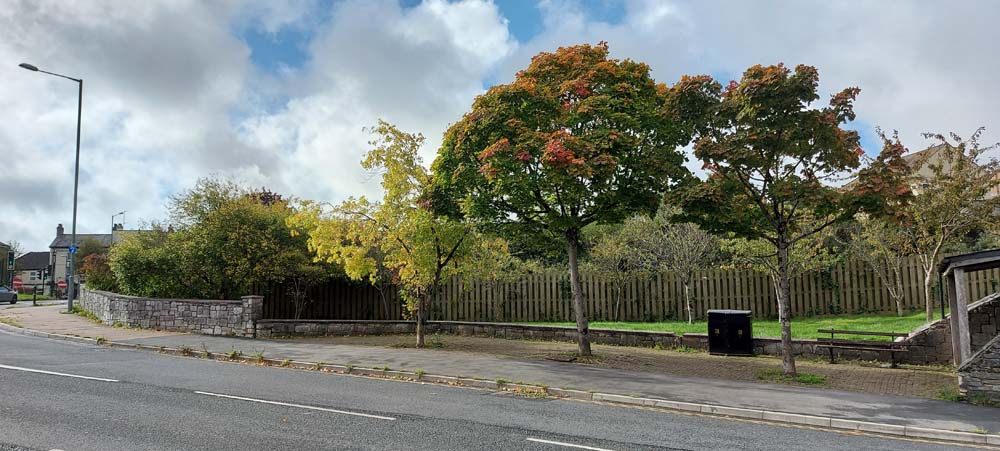
Across the road bridge, the site of the old school was planted by Antony Estates after the tunnel was opened in 1998. It shows a range of acers/maples (the best of which is silver maple planted in the pavement itself), a prunus cerasifera and various others yet to be identified.
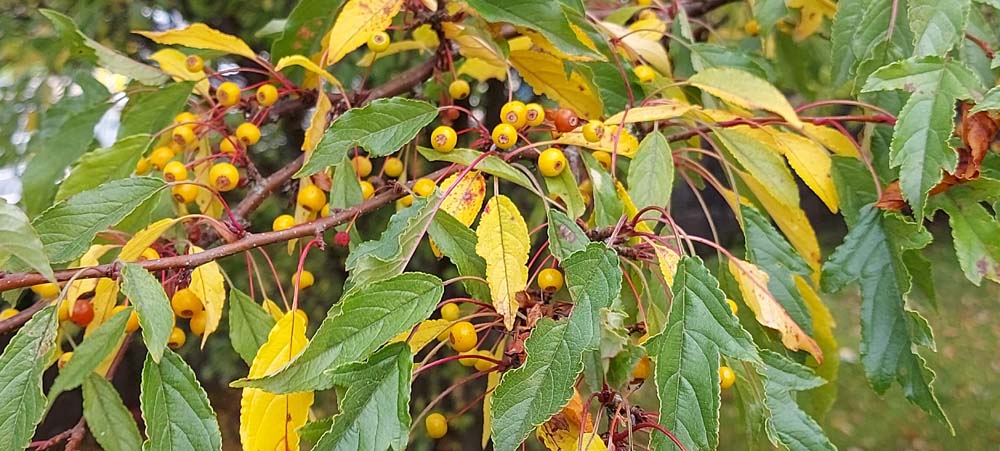
Behind these and overlooking the cutting itself is an unusual tree with some leaves a bit like a maple, and others more like crab apple. In Autumn, it yellow fruit, similar to a small crab apple. Its official name is Eriolobus trilobata and it doesn’t yet have a common name. It could be a cross between crab apple and rowan.
On the North side of North Road, where historically was a plantation of poplars, are plantings of Maritime pine, (previously I wrongly named this Scots pine) some form of lime (probably) and Cornish elm.
The walk finishes behind the Guildhall where two trees are squeezed, both large fine specimens: a yew, and a Lucombe oak, a hybrid between cork oak and Turkey oak. Look out for the occasional acorns with fancy, hairy cups.